I’m building Farka to make it easier to teach a model a specific job: give it examples, train it, compare what changed, and export the result.
One small demo starts with a familiar problem. A support request arrives. Which team should handle it?
Give the model a clear job
The task had three destinations: billing, account help and technical support. The model chose a team. It did not answer the customer, issue a refund or change an account.
We fine-tuned Qwen3.5 9B using 270 generated training examples. The run completed on 21 August 2026. This post revisits that existing result; it isn’t announcing a new training run.
Compare what changed
The saved evaluation contains before-and-after predictions for the same 30 test messages.
| Model | Requests routed correctly |
|---|---|
| Before training | 23 / 30 |
| After training | 30 / 30 |
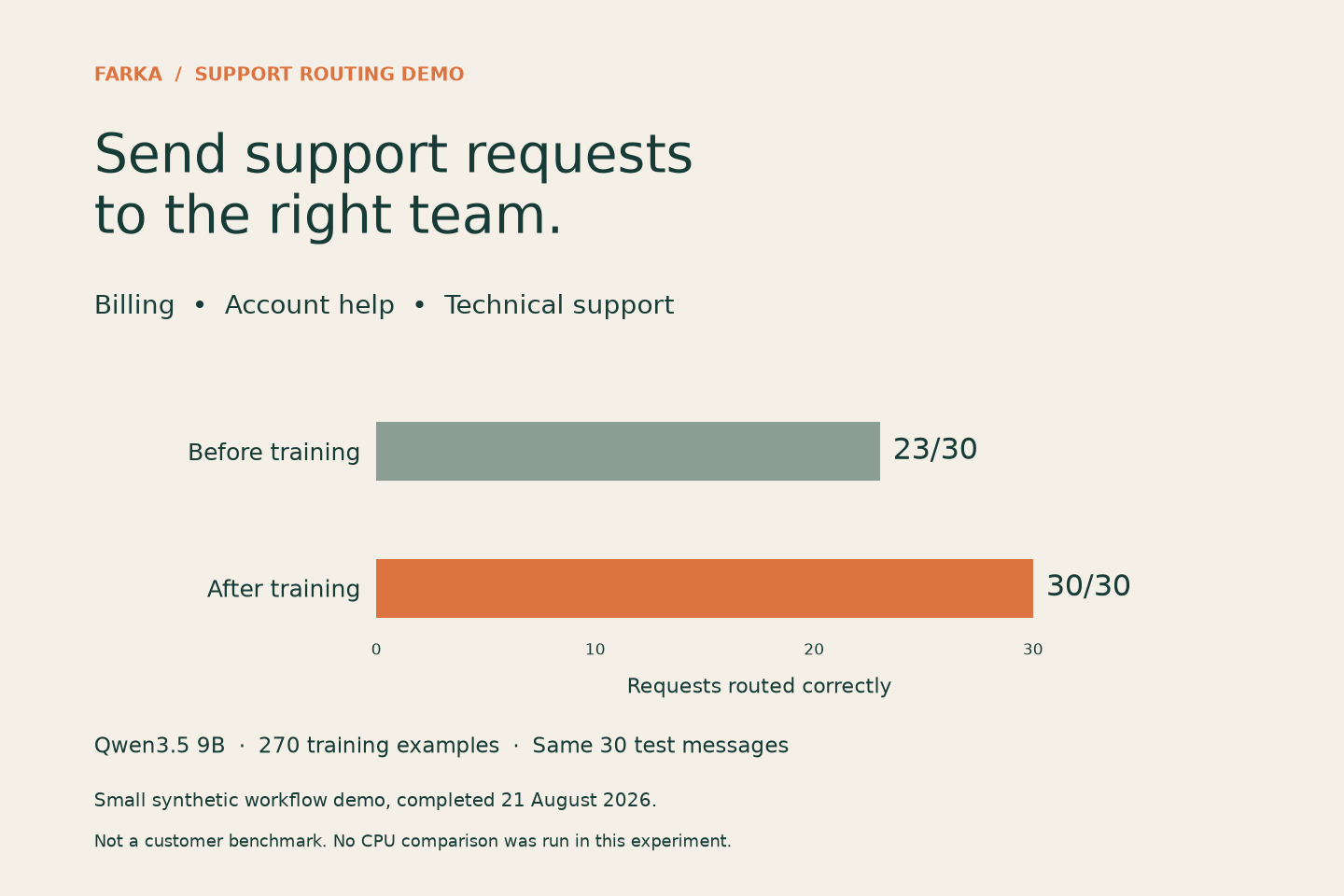
That is seven additional correct routes in this test. Both versions returned a valid team name for all 30 messages, so the change here is in choosing the recorded destination.
I checked those counts against the saved predictions. I did not rerun inference for this article.
How to read this result
This is a small synthetic workflow demonstration, not a customer benchmark. Thirty generated messages cannot establish production accuracy or a saving on a customer’s bill.
The evaluation rows also participated in checkpoint evaluation. There was no separate blind test, and I have not independently re-audited overlap between the training and evaluation message patterns. The full training protocol matters when interpreting a result this small.
There was also no comparison with a simple classifier in this run. Improving a language model does not establish that it is the best tool for the task. Rules, a classifier or better prompting may be enough.
Inspect the evidence
You can download the 30 paired predictions, the evaluation summary and training settings, and a small Python audit script.
Put those three files in one folder and run:
python3 check_predictions.py
It should print before: 23/30 and after: 30/30. The evidence notes explain the provenance and omissions; checksums identify the files.
The CSV contains row hashes and recorded labels, not the original request text. The weights are not included. This lets you audit the reported counts, but it is not a complete reproduction package or an independent check of the labels.
Where Farka fits
The part I want Farka to make easier is that comparison loop. Start with a task you can describe and examples you have permission to use. Keep a meaningful test separate. See whether training helps before deciding to use the model.
For a real workflow, I would want a larger, independently held-out test, realistic mistakes and a simpler baseline before making a quality or cost claim.
You can explore the platform at farka.ai.